H Marts are usually situated on the outskirts of the city and serve as a secondary center for strip malls of Asian storefronts and restaurants that are always better than the ones found closer to town. We’re talking Korean restaurants that pack the table so full of banchan side dishes that you’re forced to play a never-ending game of horizontal Jenga with twelve tiny plates of stir-fried anchovies, stuffed cucumbers, and pickled everything. This isn’t like the sad Asian fusion joint by your work, where they serve bell peppers in their bibimbap and give you the stink eye when you ask for another round of wilted bean sprouts. This is the real deal.
You’ll know that you’re headed the right way because there will be signs to mark your path. As you go farther into your pilgrimage, the lettering on the awnings slowly begins to turn into symbols that you may or may not be able to read. This is when my elementary-grade Korean skills are put to the test—how fast can I sound out the vowels in traffic? I spent more than six years going to Hangul Hakkyo every Friday, and this is all I have to show for it. I can read the signs for churches, for an optometrist’s office, a bank. A couple more blocks in, and we’re in the heart of it. Suddenly, it’s another country. Everyone is Asian, a swarm of different dialects crisscross like invisible telephone wires, the only English words are HOT POT and LIQUORS,and they’re all buried beneath an assortment of glyphs and graphemes, with an anime tiger or a hot dog dancing next to them.
Inside an H Mart complex, there will be some kind of food court, an appliance shop, and a pharmacy. Usually, there’s a beauty counter where you can buy Korean makeup and skin-care products with snail mucin or caviar oil, or a face mask that vaguely boasts “PLACENTA.” (Whose placenta? Who knows?)There will usually be a pseudo-French bakery with weak coffee, bubble tea, and an array of glowing pastries that always look much better than they taste.
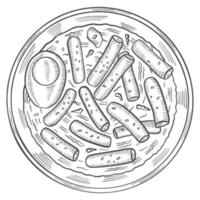
My local H Mart these days is in Elkins Park, a town northeast of Philadelphia. My routine is to drive in for lunch on the weekends, stock up on groceries for the week, and cook something for dinner with whatever fresh bounty inspires me. The H Mart in Elkins Park has two stories; the grocery is on the first floor and the food court is above it. Upstairs, there is an array of stalls serving different kinds of food. One is dedicated to sushi, one is strictly Chinese. Another is for traditional Korean jjigaes, bubbling soups served in traditional earthenware pots called ttukbaegis, which act as mini cauldrons to ensure that your soup is still bubbling a good ten minutes past arrival. There’s a stall for Korean street food that serves up Korean ramen (basically just Shin Cup noodles with an egg cracked in); giant steamed dumplings full of pork and glass noodles housed in a thick, cakelike dough; and tteokbokki, chewy, bite-sized cylindrical rice cakes boiled in a stock with fish cakes, red pepper, and gochujang, a sweet-and-spicy paste that’s one of the three mother sauces used in pretty much all Korean dishes. Last, there’s my personal favorite: Korean-Chinese fusion, which serves tangsuyuk—a glossy, sweet-and-sour orange pork—seafood noodle soup, fried rice, and black bean noodles.
The food court is the perfect place to people-watch while sucking down salty, fatty jjajangmyeon. I think about my family who lived in Korea, before most of them died, and how Korean-Chinese was always the first thing we’d eat when my mom and I arrived in Seoul after a fourteen-hour flight from America. Twenty minutes after my aunt would phone in our order, the apartment ringer would buzz “Für Elise” in MIDI, and up would come a helmeted man, fresh off his motorcycle, with a giant steel box. He’d slide open the metal door and deliver heaping bowls of noodles and deep-fried battered pork with its rich sauce on the side. The plastic wrap on top would be concave and sweating. We’d peel it off and dribble black, chunky goodness all over the noodles and pour the shiny, sticky, translucent orange sauce over the pork. We'd sit cross-legged on the cool marble floor, slurping and reaching over one another. My aunts and mom and grandmother would jabber on in Korean, and I would eat and listen, unable to comprehend, bothering my mom every so often, asking her to translate.
I wonder how many people at H Mart miss their families. How many are thinking of them as they bring their trays back from the different stalls. If they’re eating to feel connected, to celebrate these people through food. Which ones weren’t able to fly back home this year, or for the past ten years? Which ones are like me, missing the people who are gone from their lives forever?